 | This article does not cite any sources. (March 2022) |
Difficulty is a choice players are prompted to choose before starting the main game or sometimes side games. Usually a “Normal” or "Standard" difficulty represents the standard difficulty and the way the game is meant to be played and experienced. Difficulty usually amplifies the strength of the enemies while increasing the scarcity of items. It may sometimes alter some features and routes within the game.
History
Difficulty choices weren't formally implemented right away or used a standard across titles for a while.
The first Resident Evil did not have hard mode, so Resident Evil: Director's Cut was developed to further challenge players.
Due to the fact that Japan, at the time, had laws forbidding the rental of video games or the resale of used games, the three PlayStation Resident Evil games were made more difficult for their USA releases so that players would buy the game, as it would be harder to complete them if you rented them. Later releases of Resident Evil 2 in Japan included this more challenging version a setting called USA Mode.
Resident Evil 0, the Resident Evil remake, Resident Evil Survivor, and Resident Evil: Dead Aim all used a straightforward method of re-calculating numbers from picks up for Ink Ribbons and ammo to damage taken/given, rather than rearranging item placements or events.
In Resident Evil 4 onwards, most games' difficulty worked in tandem with the Rank mechanic to dictate changes, mostly without changing item placement or events. These games also use the standard "Easy/Normal/Hard" settings seen in gaming in general.
Resident Evil (2002)
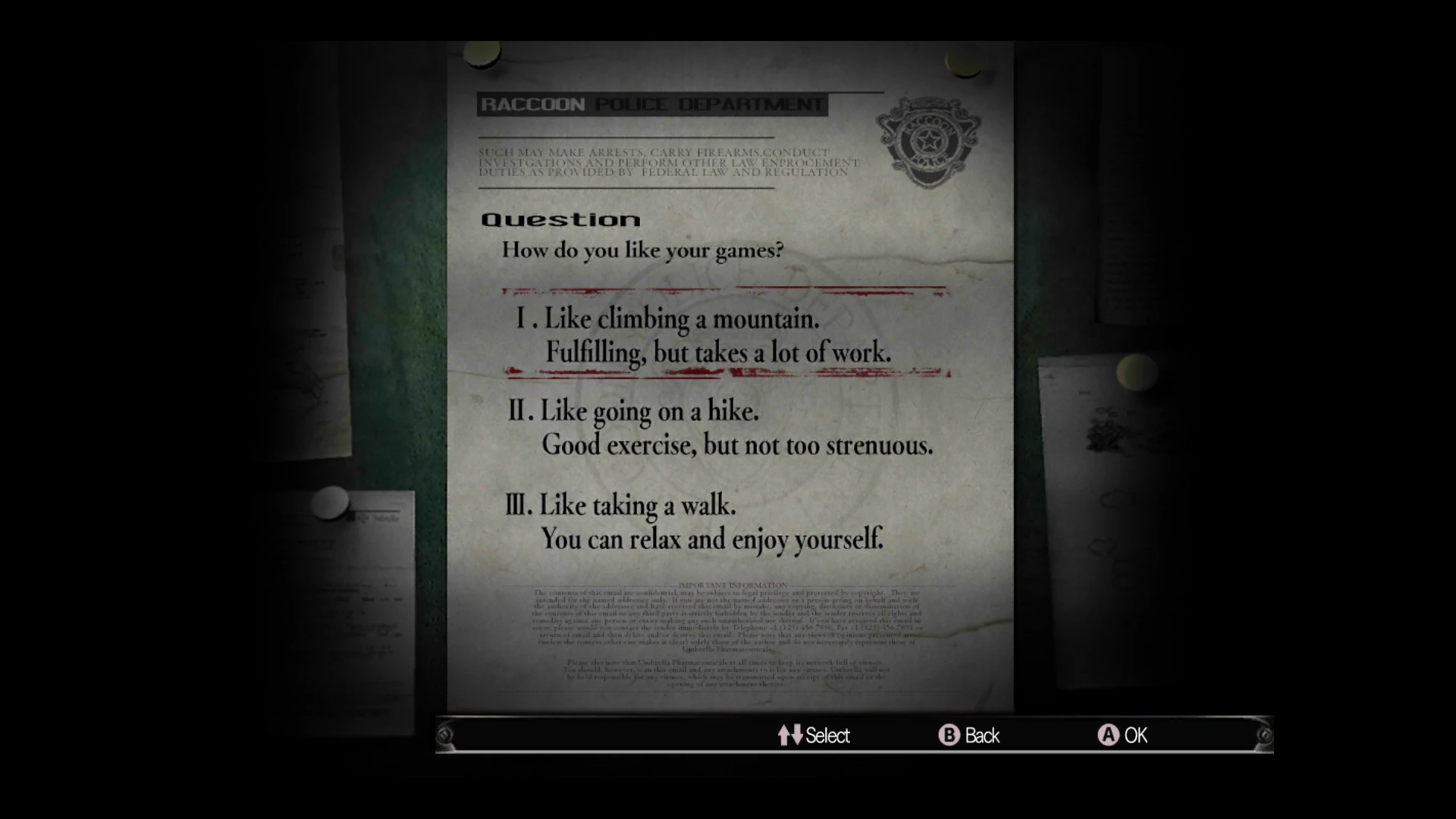

The Questionnaire as it appears in the remaster.
For the remake, the lower difficulty modes are selected in the form of a questionnaire handed to players when selecting "New game". This in-universe style was chosen by the developers due to a belief too many players instinctively selected "Easy"; difficulties were also deliberately listed in reverse order. In the GameCube and Wii versions, Easy and Normal are available at the start of the game, with Hard being made available by the "Once again..." menu option. In the 2015 remaster, an additional "Very Easy" is available in the questionnaire. Completing Hard unlocks "Real survival", and completing that unlocks "Invisible enemy".
| Difficulty | Alternate name | Colour |
|---|---|---|
| Very Easy | Like taking a Walk | Pink/purple |
| Easy | Like going on a Hike | Green |
| Normal | Like climbing a Mountain | White |
| Hard | NA | Red |
| Very Hard | Real Survival | Blue |
| Extremely Hard | Invisible Enemy | Orange |
Resident Evil 2 (1998)
On Easy mode, Leon Scott Kennedy and Claire Redfield start out with an additional 120 HP, more gun bullets, and three First Aid Sprays once they reach the Item Box. Also, when using an Ink Ribbon to save progress, it will be colored white instead of blue or red.
Nightmare and Expert modes are available only for the Dreamcast and Windows Ports. Although Arrange mode was featured in the GameCube and PlayStation versions, Nightmare and Expert are missing for unknown reasons. In these modes, enemies will cause a lot more damage, ammo/health items will become a lot more scarce, and certain monsters can usually take your health from Fine to Danger in one hit. This happens more often with Lickers.
Resident Evil 3: Nemesis
Easy: In Resident Evil 3: Nemesis, Jill Valentine will starts with a First Aid Kit, an assault rifle and two clips of ammo. Also, all weapons are available at the Item Box (except the grenade launcher, rocket launcher, and Gatling). Ink Ribbons are also affected; their amount is infinite, allowing the player to save as much as they want. However, Special Weapons parts (which players can obtain by defeating the Nemesis-T Type) are not available.
Hard: Jill starts with only a handgun and the Reloading Tool. In the Item Box, only the knife is available. However, Special Weapons are available after collecting parts obtained by defeating the Nemesis-T Type. There are only 8 inventory slots (10 slots after Carlos Oliveira gives Jill the "Suspender"). Some other items are also obtainable by defeating Nemesis.
Resident Evil CODE: Veronica
Difficulty select is only available in Japanese versions of Code Veronica.
- Very Easy
- Easy
- Normal
Resident Evil 0
- Easy
- Normal
- Hard
Resident Evil: Outbreak
In Resident Evil Outbreak, it is unlocked after completing the Decisions, Decisions scenario. 2000 points are needed to purchase it. In Resident Evil Outbreak File 2, It is unlocked after completing the "end of the road" for the same price.
Very Hard: It's unlocked in both titles by completing all five main scenarios in Hard mode.
- Items are very scarce, and most of them will be replaced by key items.
- Enemies are at their strongest; players will often find themselves run out of ammunition should they engage enemies in the game, even down to the more common zombies. This prompts a more evasive and cunning playstyle instead.
- Puzzles are harder to figure and require slightly more backtracking compared to easier modes.
- Some event checklist are exclusive to Very Hard mode, thus players are required to play the mode through to achieve 100% checklist.
- A supplementary option dubbed "Nightmare" can be unlocked in Outbreak 2 which further increases enemy aggression and damage; rendering most zombies as hyper zombies, whilst increasing the enemies' overall damage output.
Outbreak series feature starkly different experience in this mode. A prime example being during the level Outbreak, in which Bob becomes a zombie and will attack Mark instead of committing suicide as in easier modes.
On the mainline entries, the mode often forced players to be quick on their feet and adapt to a more aggressive composition of enemies ergo their AI behavior.
Oftentimes, the mode punishes players to near-death state with a single hit for any form of mistake.
Nightmare can be purchased in the Store for 10000 Points after Finishing each Scenario in the game on the Very Hard difficulty. In this mode, the only thing that changes in the gameplay is that healing items heal only 75% of their usual percentage and enemies can inflict 30% more damage to the player character. As an interesting addition, it can be used with any level of difficulty, which keeps the same location for items and enemies in their specific difficulty without changing. For very experienced players, one should try to combine Nightmare mode with Very Hard difficulty and achieve a No Damage Taken bonus; This rewards players with more than 10000 points for the collection.
Resident Evil 4
Successfully beating the game once on the default Normal mode will unlock Professional mode. The difficulty is selected when starting a new game and cannot be changed mid-game or for a New Round.
Easy Mode is not available on any NTSC console versions of the game. It was later added to the HD PC release. All PAL/NTSC-J console versions feature Easy mode. Easy mode not only makes aspects generally more lenient, but also removes chunks of the game in the castle section.
- Ammo
- Easy - Ammo is a lot more common.
- Normal - Ammo-drops are set to default.
- Professional - Ammo from enemies is less common and mostly replaced by money, which is now dropped slightly more often than in the easier modes.
- Game Rank
- Easy - Rank is in effect, but is less severe.
- Normal - Rank is in effect, and is more severe.
- Professional - Rank is set to 10, causing the game to stay the same in terms of enemy attack power and AI.
- Enemies
- Easy - All enemies are weaker and do less damage.
- Normal - All enemies have base health and deal normal damage.
- Professional - All enemies have increased health and deal more damage, making it ill-advised to try and kill them all.
- Enemy AI
- Easy - Enemy attack power and AI are decreased.
- Normal - Enemy attack power and AI are set by default.
- Professional - Enemy attack power and AI are increased: they will attack faster and move faster towards the player.
- Prompts
- Easy - All button prompts give the player plenty of time to react and do pushes.
- Normal - All button prompts have a base amount of time but require quicker reactions and more pushes.
- Professional - All button prompts require much quicker reactions and even more pushes.
Change exclusive to Professional mode:
- On all versions except GameCube (in which it actually has no effect in this mode), the Tactical Vest is unavailable.
Changes exclusive to Easy mode:
- A full stack of rifle bullets holds 20 instead of 10, and a full stack of shells holds 25 instead of 15.
- In Chapter 1-1, rather than being found in the village, the shotgun is in the player's inventory at the start, with 15 shells.
- In Chapter 3-1, the Castle Gate Key room is inaccessible, as the gate is already unlocked, so players can go directly into Salazar Castle.
- In Chapter 3-1, the two RPG-wielding cultists in the castle parlour are absent.
- In Chapter 3-2, the maze is inaccessible, and the door where Leon meets Ada Wong is already open, thus the player can proceed to the door to continue the game. Moreover, the second Red Gem is now relocated from the maze to the dining hall.
- In Chapter 3-3, no cultists appear in the room with the free RPG.
- In Chapter 3-4, only one of the Armaduras comes alive to chase Ashley.
- In Chapter 4-1, the knight room is inaccessible, as the King's Grail is already in its place
- In Chapter 4-1, the clock tower is inaccessible, as the lever to rotate the bridge is now outside. No cultists appear on the bridge. In the next room, there is only one Garrador instead of two; the unarmored variant is absent.
- In Chapter 4-2, the first two Ganados in the mine and the Chainsaw Man are absent.
- In Chapter 4-3, there is only one Chainsaw Man instead of two. Also, the spiked ceiling trap will not activate, allowing the player to continue right away, although the parasites still appear.
Biohazard 4 also features Amateur difficulty, which is the same as Easy, but is just generally more lenient; more ammo spawns, enemies are weaker, weapon capacity is doubled, etc.
Resident Evil 5
Resident Evil 5 has four difficulty modes, Amateur, Normal, Veteran, and Professional. Professional is only unlocked after Veteran is finished.
Several variables will change depending on difficulty.
- The higher the difficulty, the more damage the enemies can take/deal.
- The higher the difficulty, the less health the vehicle has.
- The higher the difficulty, the less often that ammo/items will appear.
- The higher the difficulty, the less time the player has to perform a QTE after a cutscene.
- Mini-bosses will change.
- On Amateur, some mini-bosses (e.g. Chainsaw Majini) do not wake up after players defeat them.
- On Normal, at lower difficulty adjustment (DA) values, some mini-bosses like Chainsaw Majini do not wake up after players defeat them.
- On Veteran and Professional, the Chainsaw Majini is able to attack a second time after you defeat him, this time in an enraged frenzy that attacks anything in sight.
Changes exclusive to Professional mode:
- You inflict only 85% of usual damage.
- Enemies stagger much less. It only takes a second or two for a KO'd enemy to stand up again.
- Enemy melee attacks inflict 10x damage. Hand-to-hand attacks are less severe, but still deal more damage.
- When in dying status, the player has under 3 seconds to be revived or revive their partner.
- All money picked up is doubled in value (e.g. gold bars are worth 6,000 instead of 3,000).
- All ammo picked up amount also increased.
- All fixed ammo/grenade placements on the map are deleted, but healing items stay also predetermined ammo/grenade from breaking box all were random.
- Herbs are no longer dropped by enemies and broken boxes, instead replaced by money/ammo.
- Emergency herb or ammo no longer dropped if player is in tight situation.
- Button prompts require quicker reaction time and more complicated combinations, as well as instant failure upon pressing the wrong button.
- In single-player games, enemies like The Majini will target only you; ignoring your AI partner throughout the majority of the gameplay and is only targeted in certain situations. For example, in the worship area of Chapter 4-2, the AI Sheva Alomar is needed to retrieve one of the slates in order to continue navigating the area successfully, however, the enemy will attack your partner.
Resident Evil: Revelations
In the 3DS version of Resident Evil: Revelations, "Hell" (designed to 'Test the limit of your sanity' as the difficulty describes) applies the following game changes:
- Enemies do more damage and are also able to take more damage
- The wire puzzle gets more complicated compared to Normal and Casual.
- Hunters have a high probability of doing their Throat-slit move, which instantly kills the player.
- Players also find Ammo Bags that did not exist in Normal or Casual to expand the ammo limit.
- Along with Ammo Bags, players also find Illegal Custom Parts which did not exist in Normal or Casual.
In the HD port, Hell mode is replaced by “Infernal”. The description is unchanged. In Infernal, applied game changes:
- Enemies do insanely more damage and are also able to withstand more damage before dying.
- Enemies are placed differently as well as powerful enemies being put in earlier chapters.
- Items that were made easier to find are now hidden.
- Ammunition and other items are very scarce.
- Players are able to find Ammo Bags which did not exist in Normal or Casual.
- Along with Ammo Bags, they are also able to find Legendary Custom Parts along with P90, which exist only in Infernal.
Resident Evil 6
In Resident Evil 6, Professional and No Hope modes were unlocked by default after the December 17th, 2012 update. All difficulties affect damage dealt and damage taken.
Amateur:
- Most story progress instant deaths QTEs fail will be performed automatically (explained by the game).
- Certain enemies filling build meter QTEs is faster and action button QTEs is simplified.
Professional:
- Enemies deal high damage, taking at least 2 health blocks from a clean hit and possibly more if players fail any proceeding QTE grab prompts. It's not uncommon for players to fall into Dying state if they fail said QTEs.
- Certain enemies filling build meter QTEs now slower.
- Recover speed of damaged life cube slower.
- Every enemies AI are far more advanced for reaction of player action.
- Enemies overall behavior got speed up such as get up quickly after being stagger and knocked down.
- Enemies mutation more frequently.
- Item resources drop getting rare from enemies especially never drop green herbs and random item from breaking boxes always drop Skill Points.
No Hope:
- Enemies deal the highest damage, often taking at least 2.5 health blocks in a single hit and will put players in Dying state if players fail QTEs prompts from any follow-up attacks.
- Skills are disabled.
- Ranged enemies have far better accuracy.
- Unlike in previous modes where death respawns players to an earlier checkpoint in full health, continuing from death in this mode respawns the player in their most recent state. I.e. if the player hits a checkpoint with only 2 health blocks prior to death, they will respawn to said checkpoint with said 2 blocks of health.
- All Skill Points that appear are worth double (random skill points no longer drop 50 skill points Pawn rather all were 100 Knight instead).
Resident Evil: Revelations 2
Resident Evil: Revelations 2 has four difficulty modes: Casual, Normal, Survival, and No Escape. No Escape is only unlocked after completing the game on Survival, whereas the other three difficulties are unlocked by default.
The DLC episodes The Struggle and Little Miss only have Casual and Survival difficulties.
Countdown Mode only has Normal difficulty, and Invisible Mode only has Survival difficulty.
Higher difficulties will change these stats:
- Enemies will deal more damage
- The player has less stamina and will tire out from running more often (dodging is recommended to not trigger this tired phase)
- It will take longer to recover from lost stamina (3 seconds on Casual, 5 seconds on all other difficulties)
- The location and number of enemies will change and higher-tier enemies will replace lower-tier ones
- Enemies will take longer to get stunned by attacks / blinded by light
- The player has less health
- The player will find less ammo from breakable boxes or hidden items and find more treasures instead
- Sub-weapons deal less damage but their number and location stay the same from Normal to No Escape
Resident Evil 7: Biohazard
Resident Evil 7: Biohazard has 3 difficulties in the main game: Easy, Normal, and Madhouse. Madhouse is only unlocked after completing the game for the first time or by purchasing certain DLCs.
In the main game, Madhouse changes the game in a far more different approach compared to the previous difficulties, making the gameplay much more intense:
- Enemies are far more stronger, much faster and formidable.
- Enemies using their stronger or instant kill attacks much more often.
- Some scripted events where enemies will spawn after obtaining Key Items or unlocking new areas are slightly changed.
- Strong enemies that will be encountered later on in the game such as Quick Molded are now encountered much earlier.
- Aside from the aforementioned stronger enemies, the player will now encounter more of them.
- Saving in Video Recorders now requires Cassette Tape to save data.
- Specific Key Items now has different location or locked and will now require Antique Coins or Lock Picks to be unlocked, as opposed to tracking them in rooms.
- More Antique Coins are scattered around the game's locations, with some being in objects that the player can examine.
- The Main Hall now has bird cages, with some new features unique items in this difficulty such as Assault Coin or Iron Defense Coin.
- More Antique Coins are scattered around the game's locations, with some being in objects that the player can examine.
- Items in the game are harder to find such as weapon ammunition or resources.
- Separating Agent is much more frequent in this mode, forcing the player to sacrifice their resources wisely for the sake of crafting another resource.
- Less frequent auto saves.
Professional (Not A Hero) and Joe Must Die (End of Zoe) difficulties are only exclusive to the respective DLCs of the game. Both difficulties behave the same as Madhouse mode with some addition:
Professional mode forces the player to start only with a Tactical Knife while their other main weapons can be retrieved in selected locations. The Item Box also can be accessed in early selected locations and with a unique item.
Joe Must Die mode features a unique item called the Throwing Knife where its sole purpose is to simply lure enemies or set up traps due to explosive canisters and Tripwires being frequent in this mode. They can also be used as weapons, but are rather weak and are best used for the aforementioned purpose. In Additions some alternate paths are now blocked, forcing the player to choose the more dangerous areas.
Resident Evil 2 (2019)
Resident Evil 2 has three difficulty modes: Assisted, Standard, and Hardcore.
Assisted:
- The player has aim assist.
- Enemies are slightly weaker.
- The player health when in Danger state, will be able to regenerate a certain amount of without the need for healing items.
Standard:
- The standard game mode.
Hardcore:
- Enemies are tougher and stronger.
- Manual saving is done through ink ribbons and auto-saving is disabled entirely.
- Only 3 Hip Pouches can be pick up and it's all in complicated locations.
Resident Evil 3 (2020)
The Resident Evil 3 remake has five difficulty modes: Assisted, Standard, Hardcore, Nightmare, and Inferno. You must complete the game on Hardcore to unlock Nightmare, then complete Nightmare to unlock Inferno. The higher the difficulty, the stronger the enemies are.
Assisted:
- Health recovers periodically
- More ammo received when crafting
- Begin the game with the assault rifle
- Aim assist (can be turned off through the controls menu)
Standard:
- Ammo and items appear at an average rate
- Some ammo received when crafting
Hardcore:
- Ammo and items are scarcer
- Less ammo received when crafting
Nightmare:
- Enemies and items have different placement locations
Inferno:
- Fewer Item Boxes and typewriters
- No autosave
Resident Evil Village
Resident Evil Village has four difficulty modes: Casual, Standard, Hardcore and Village of Shadows, with each difficulty affecting the amounts of Lei dropped by enemies. Village of Shadows is the most challenging difficulty and must be unlocked by completing the game once. In this mode, enemies have much more health and deal significantly more damage, and are also placed differently compared to the other modes; on the other hand, players will find a lot more treasures and Lei during their adventure.
Resident Evil 4 (2023)
Resident Evil 4 has four difficulties.
Assisted:
- Aim assist is active, and can be changed in Controls from the Options menu
- Create more ammo when crafting
- Recover some health automatically when in Danger
- Lower prices for certain items
Standard:
- The standard game mode
Hardcore:
- Stronger enemies and harder challenges
- Higher prices for certain items
Professional:
- No autosave
- Parrying is limited to Perfect Parries
- All weapon modifications are available from the start
Resident Evil Requiem
Resident Evil Requiem has four difficulties: Casual, Standard (Modern), Standard (Classic) and Insanity. Starting from Standard (Classic), Grace's segment requires the use of Ink Ribbon to save data in the Typewriter.
Insanity not only increases enemy aggression and strength, but also alters the game in different ways in contrast to the easier difficulties. Some stronger enemies encountered later on such as Chunk and Blister Head are encountered much earlier or have different encounters. Item placements are also altered and resource items are scarce. Antique Coins appear more frequently in this mode while Leon score more points upon killing an enemy. Additionally, some items in the shop are more expensive than before.
| ||||||||||||||